Adobe Illustrator logo with a blue star above the 'i'.

Exploring public sentiment about Digital Twins to inform the design of AI technology

Social network analysis helps you understand what people think about an issue.

This presentation reviews public sentiment about Digital Twins and shows how we can design future AI technologies with a human centred lens.
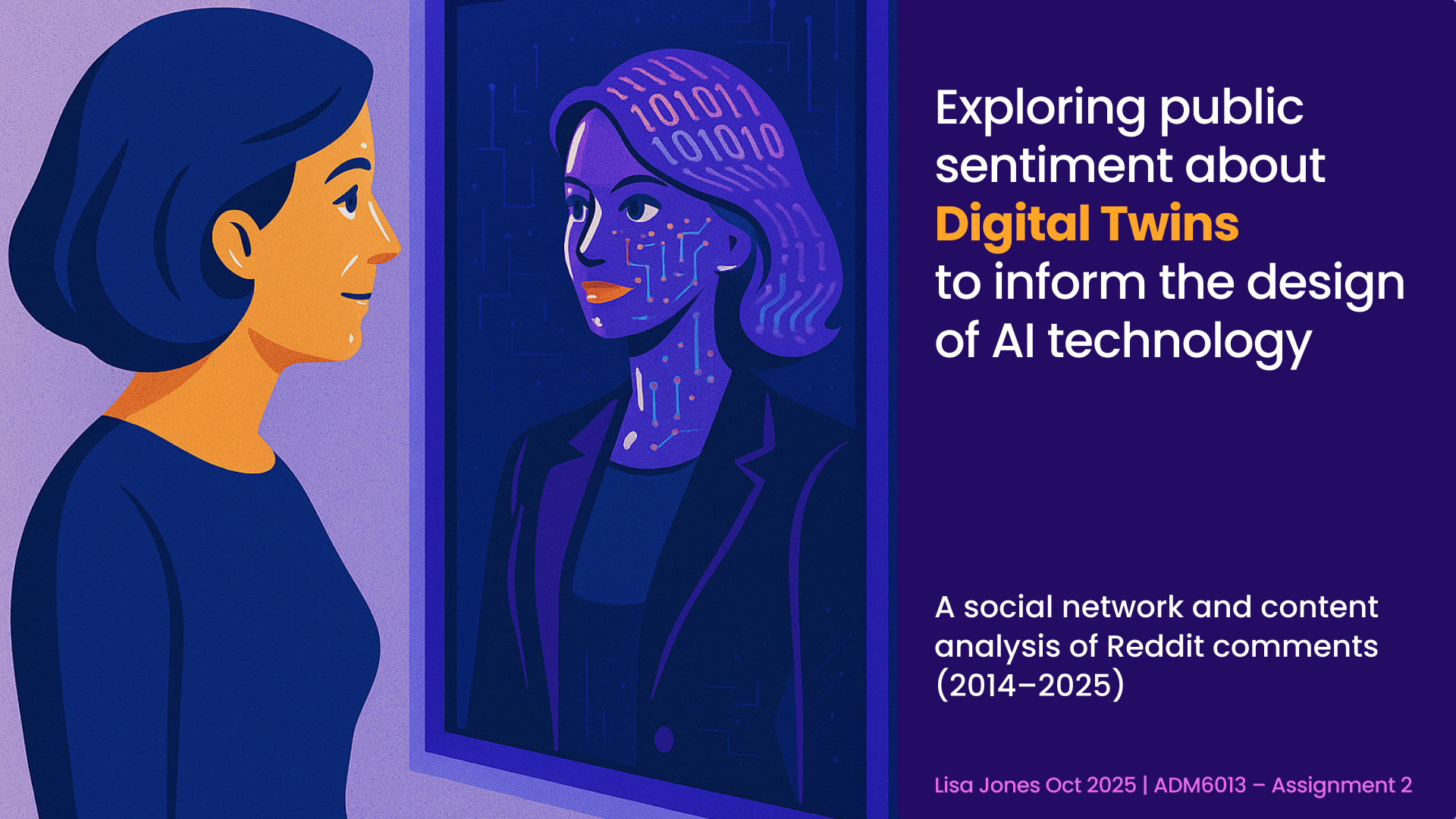
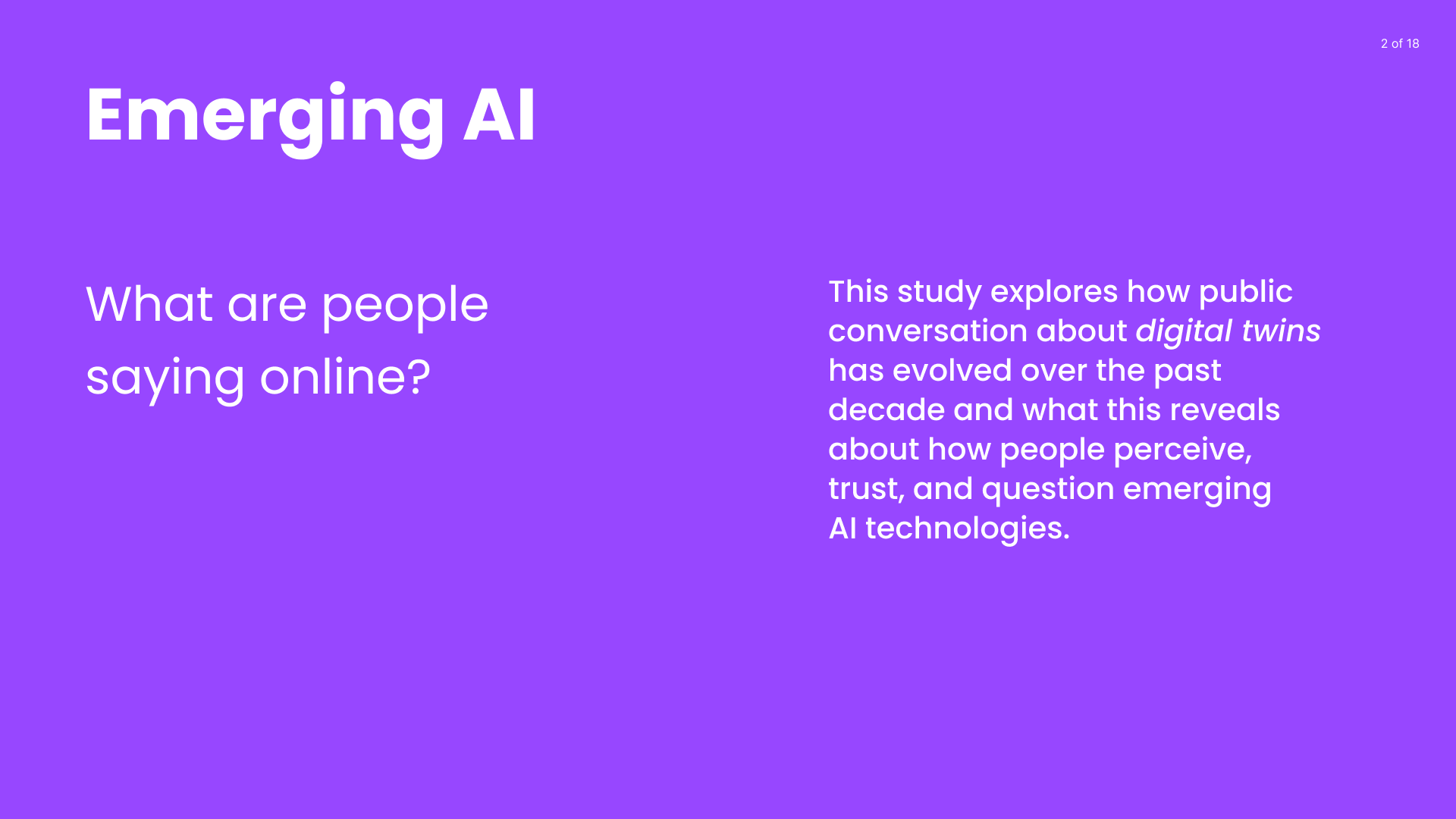
Illustration of a woman looking at a digital portrait of a woman with binary code on her face, representing digital twins and AI technology.
Slide presentation titled 'Emerging AI' with a purple background. The slide asks, 'What are people saying online?' and provides a description about a study on public conversations about digital twins and perceptions of emerging AI technologies.
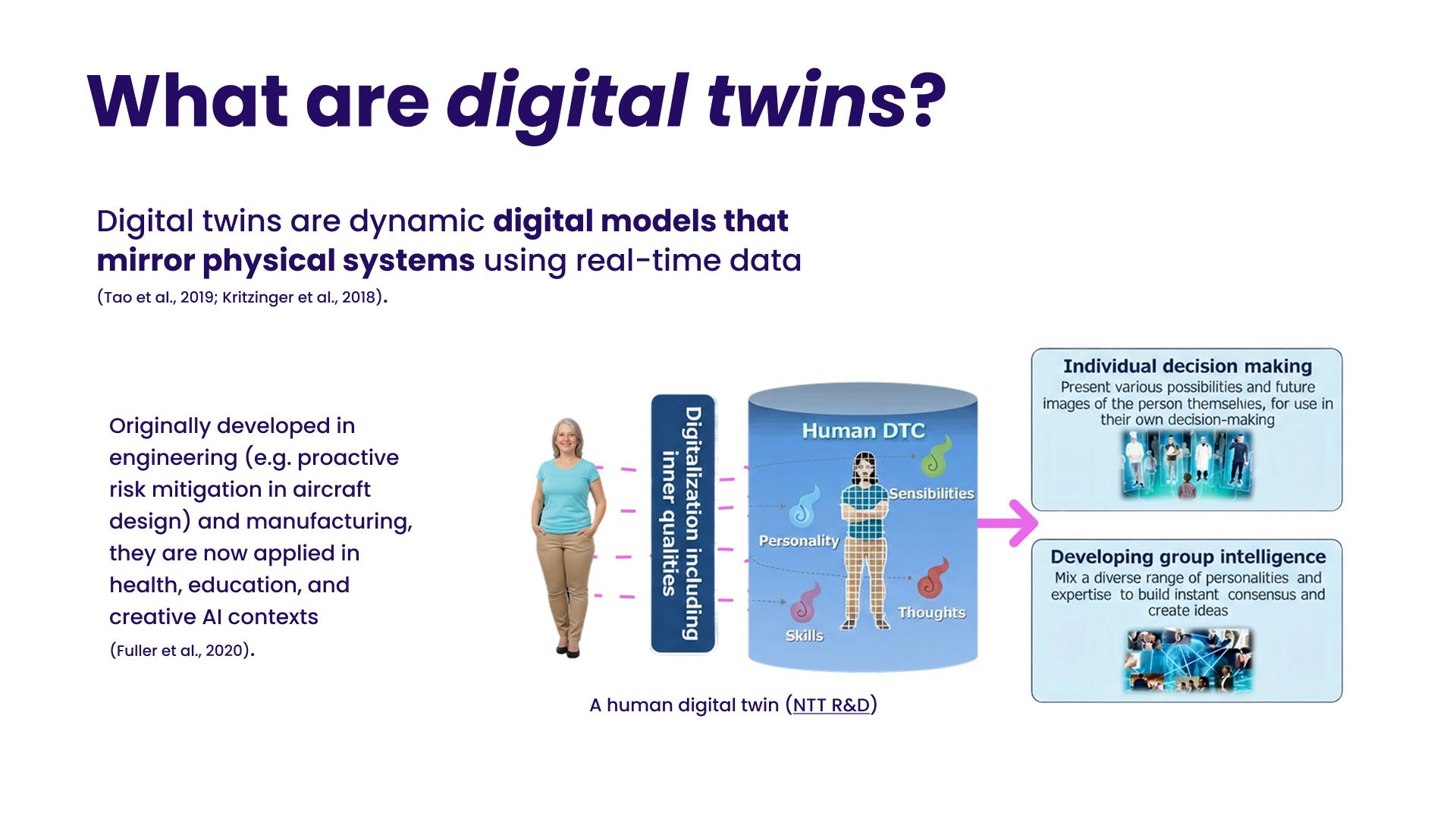
An infographic titled 'What are digital twins?' explaining digital twins as dynamic digital models mirroring physical systems using real-time data. It features a human digital twin with labels for personality, sensibilities, skills, and thoughts, and highlights applications in individual decision-making and group intelligence development.
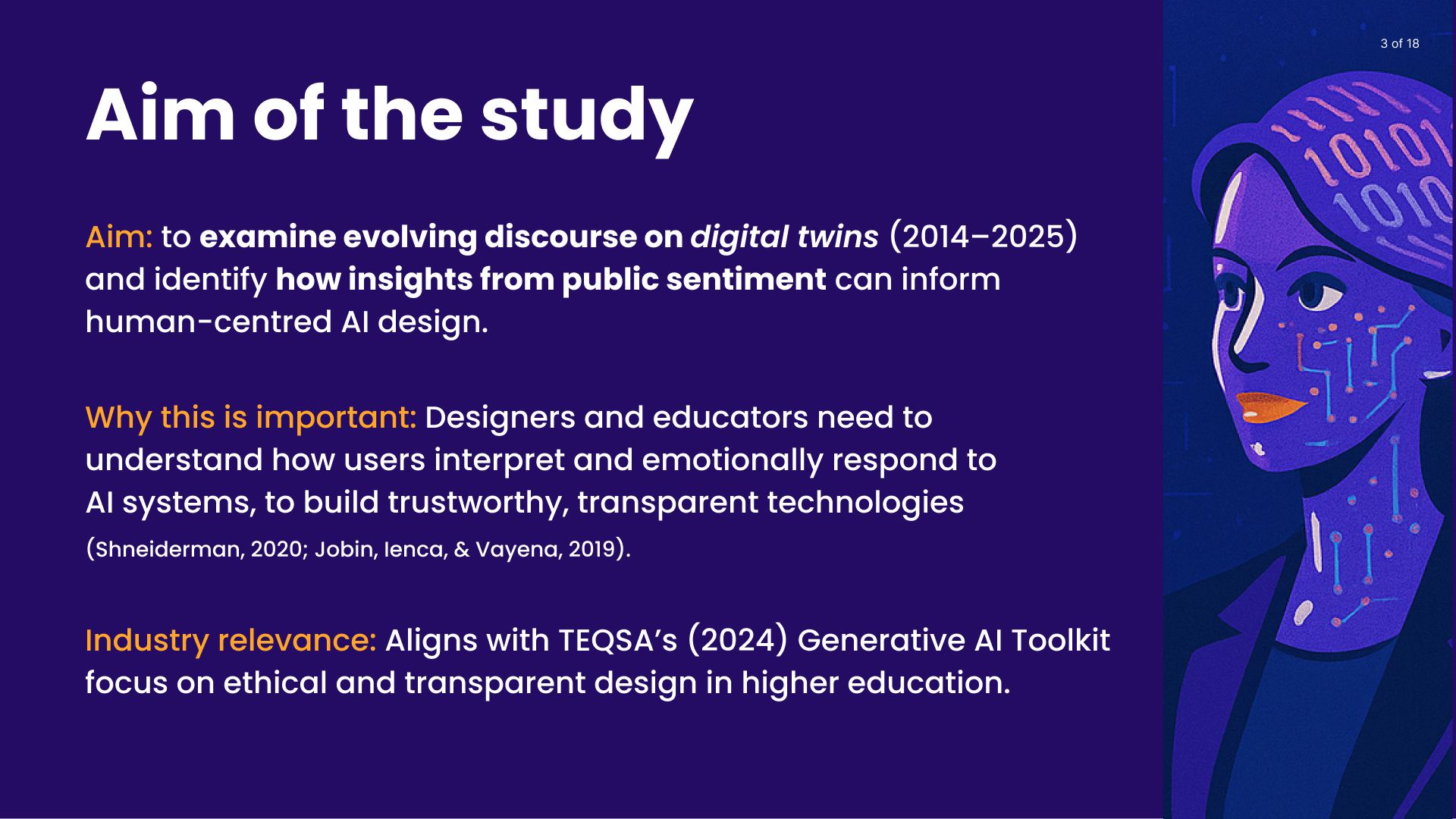
Slide titled 'Aim of the study' with white and yellow text on a dark purple background. To the right, an illustration of a woman with digital circuit patterns on her face, wearing glasses with binary code reflected.
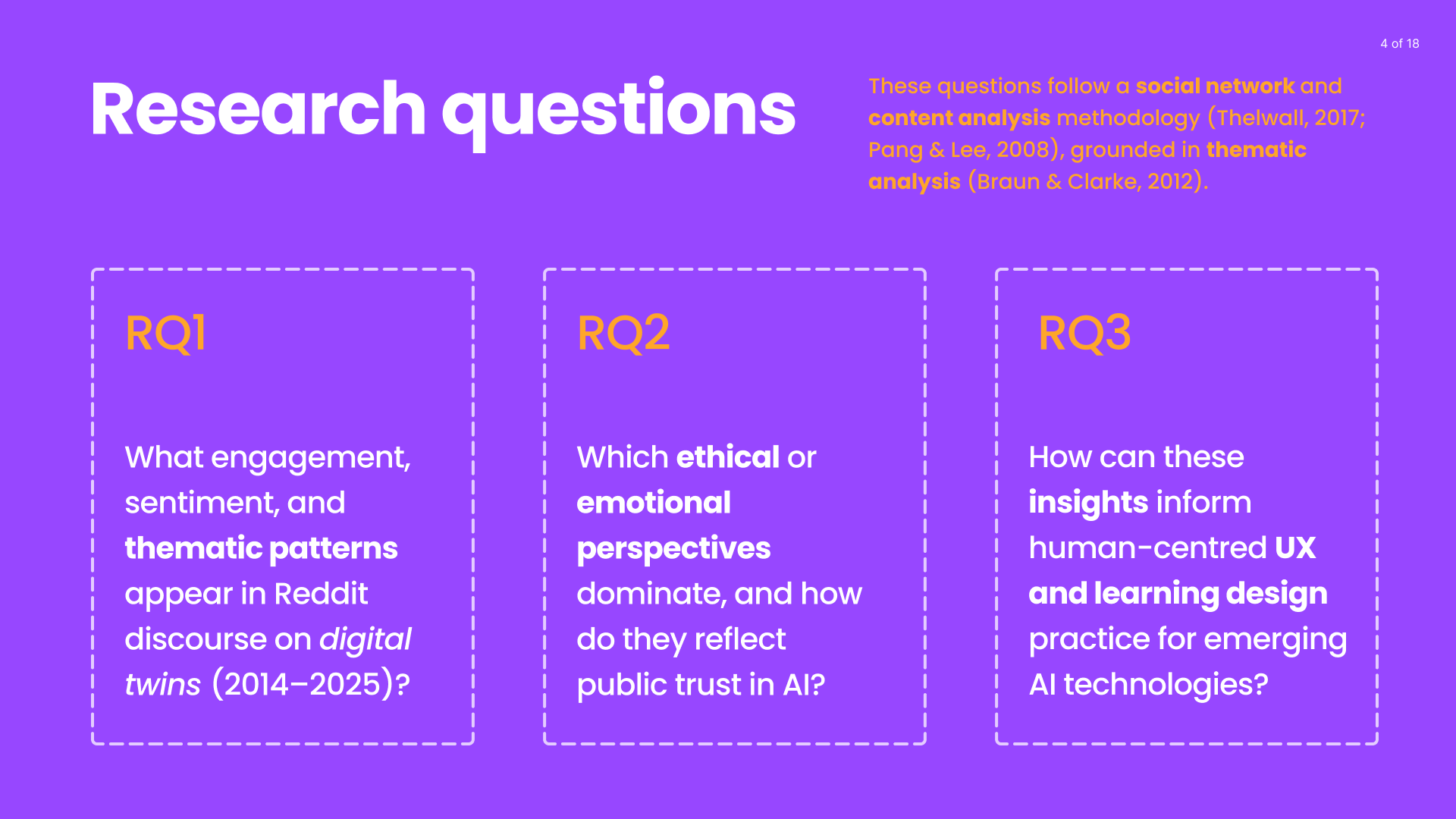
Slide with purple background displaying three research questions about Reddit discourse on digital twins and AI trust, each within dashed white boxes. The title is "Research questions" in bold white text, with explanatory text in orange, and questions labeled RQ1, RQ2, RQ3 in orange.
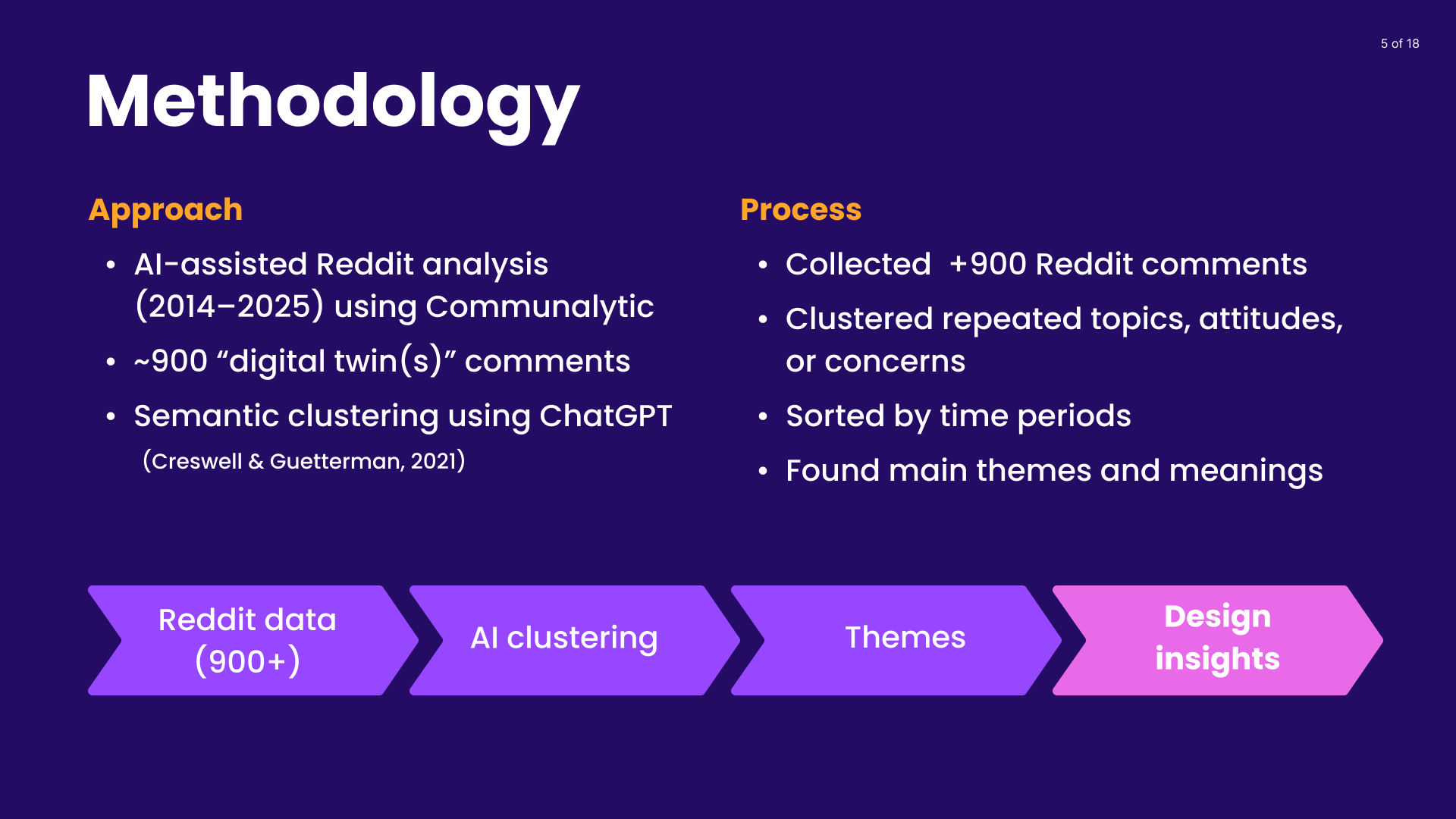
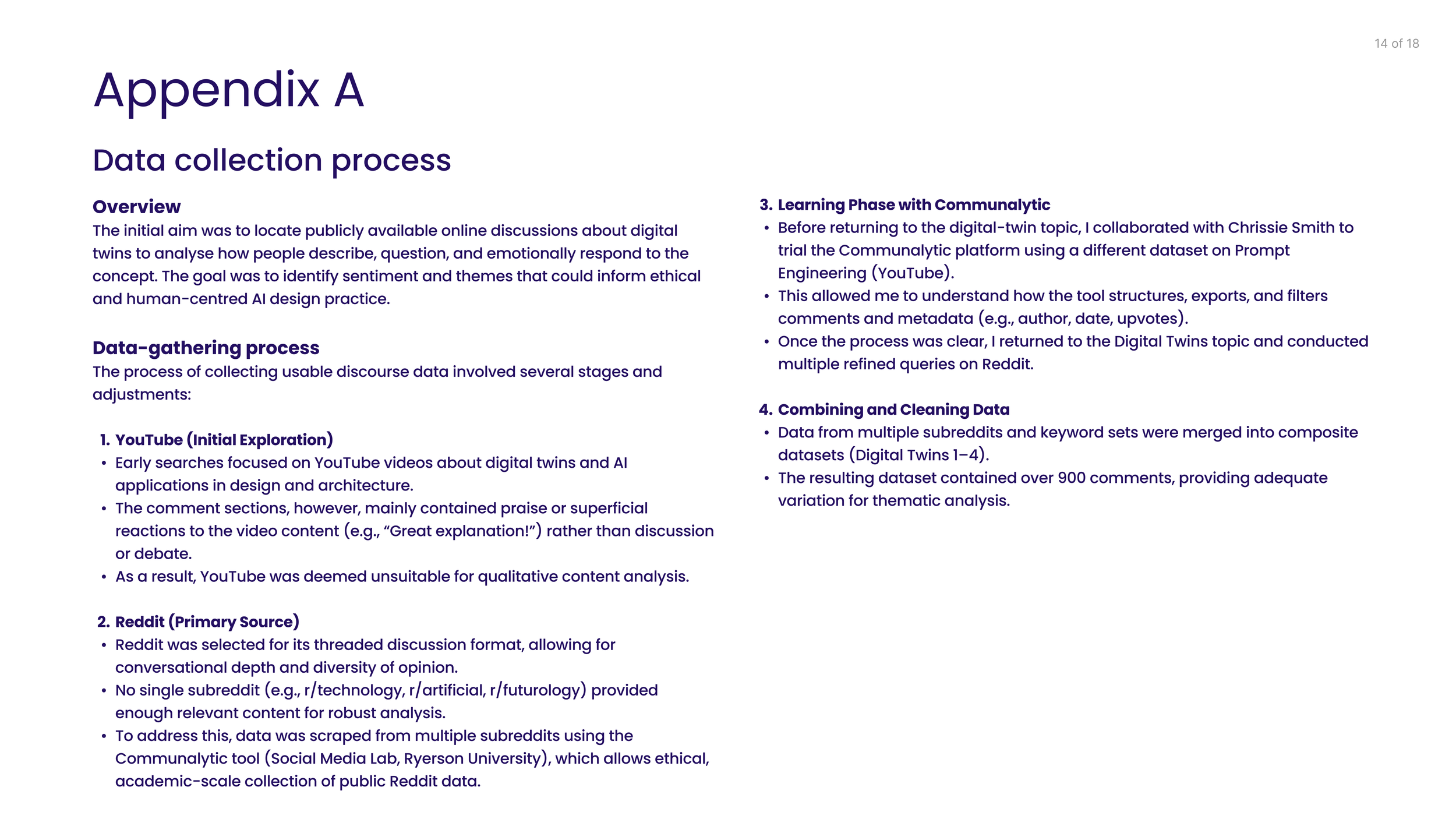
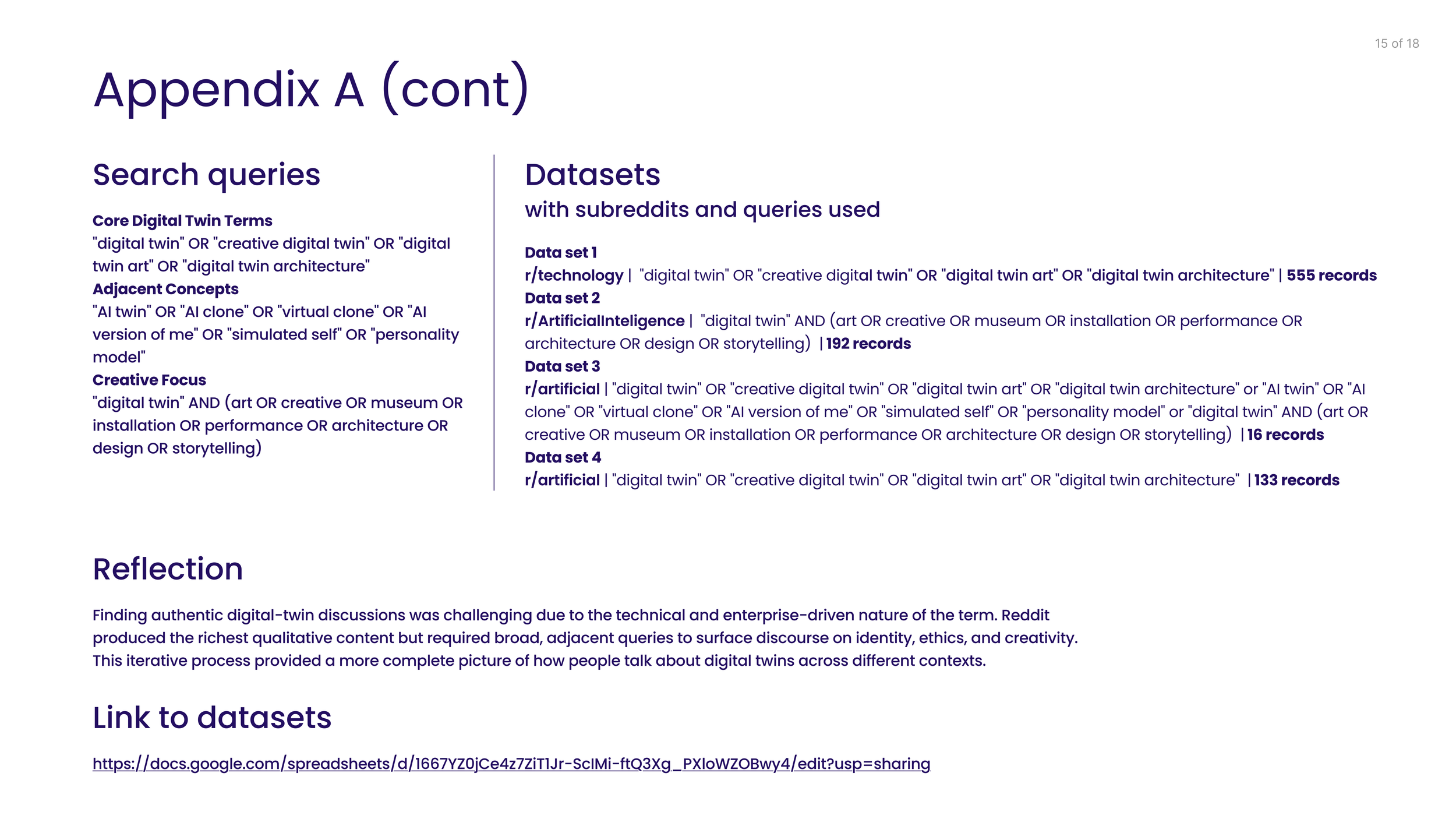
Slide titled 'Methodology' with two sections: 'Approach' on the left and 'Process' on the right. The 'Approach' section includes bullet points about AI-assisted Reddit analysis from 2014 to 2025, using Communalytic, 900 digital twin comments, and semantic clustering with ChatGPT. The 'Process' section lists collecting +900 Reddit comments, clustering themes, sorting by time, and identifying main themes. At the bottom, a flowchart with four purple and pink arrows labeled 'Reddit data (900+)', 'AI clustering', 'Themes', and 'Design insights'.
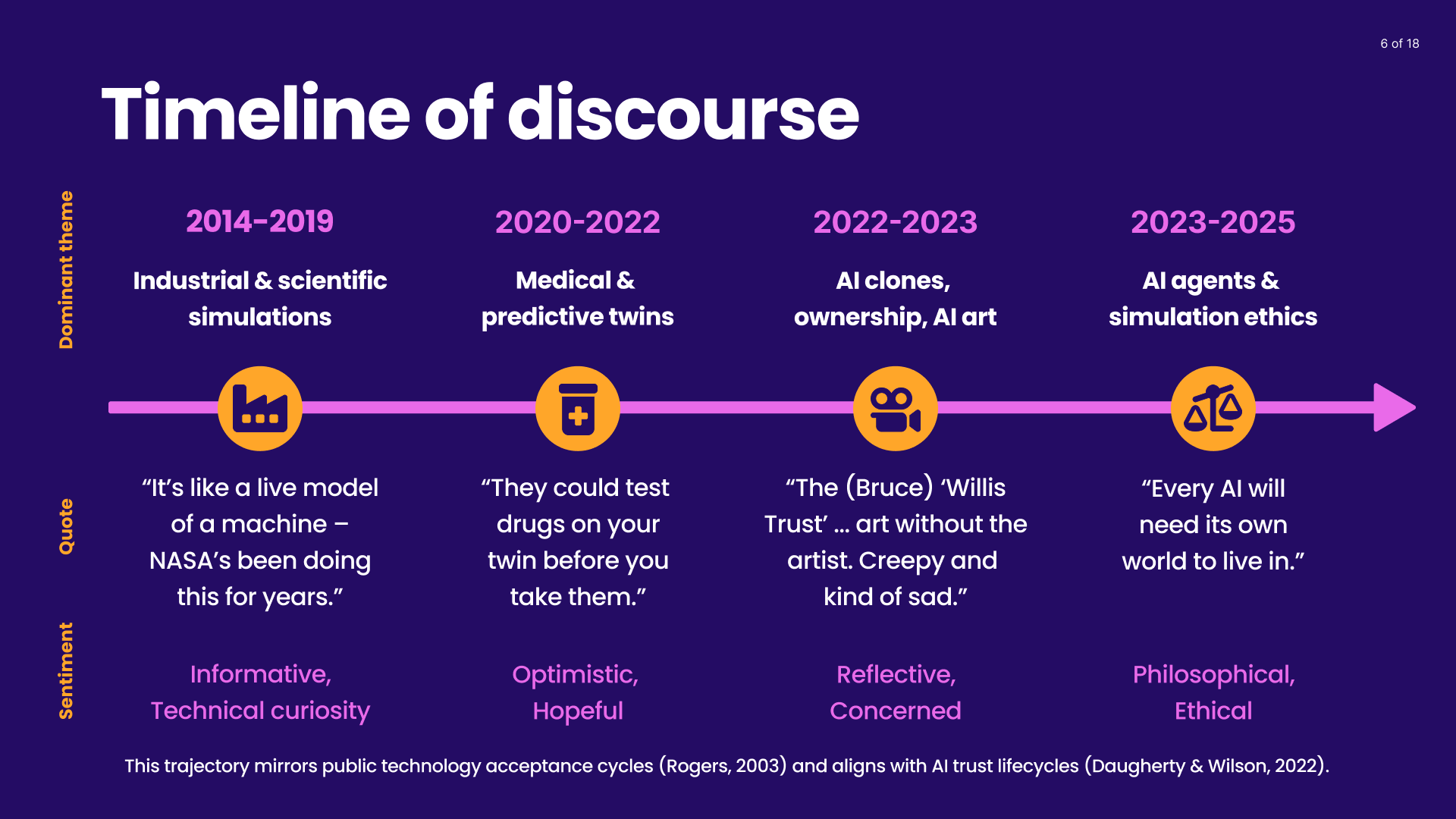
A timeline chart titled 'Timeline of discourse' shows four time periods (2014-2019, 2020-2022, 2022-2023, 2023-2025) with dominant themes: industrial and scientific simulations, medical and predictive twins, AI clones and AI art, and algorithms and ethics. Each period has a quote and mood: informative, optimistic, reflective, philosophical. A note at the bottom explains the trajectory mirrors public technology acceptance cycles and AI trust lifecycles.
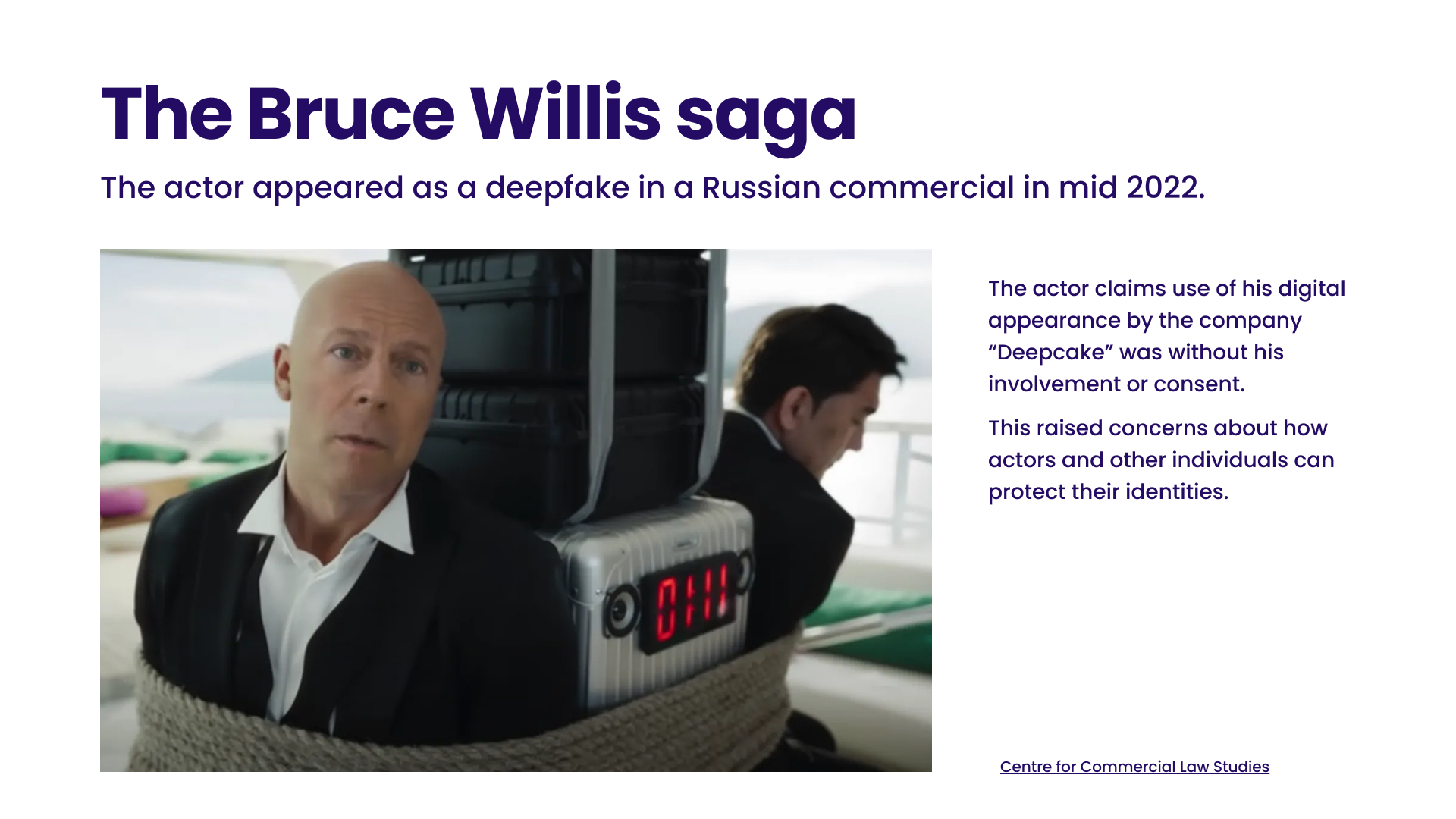
A man with a shaved head, dressed in a suit, appears on screen with a serious expression, tied to a time bomb device on a boat, with another man in the background.
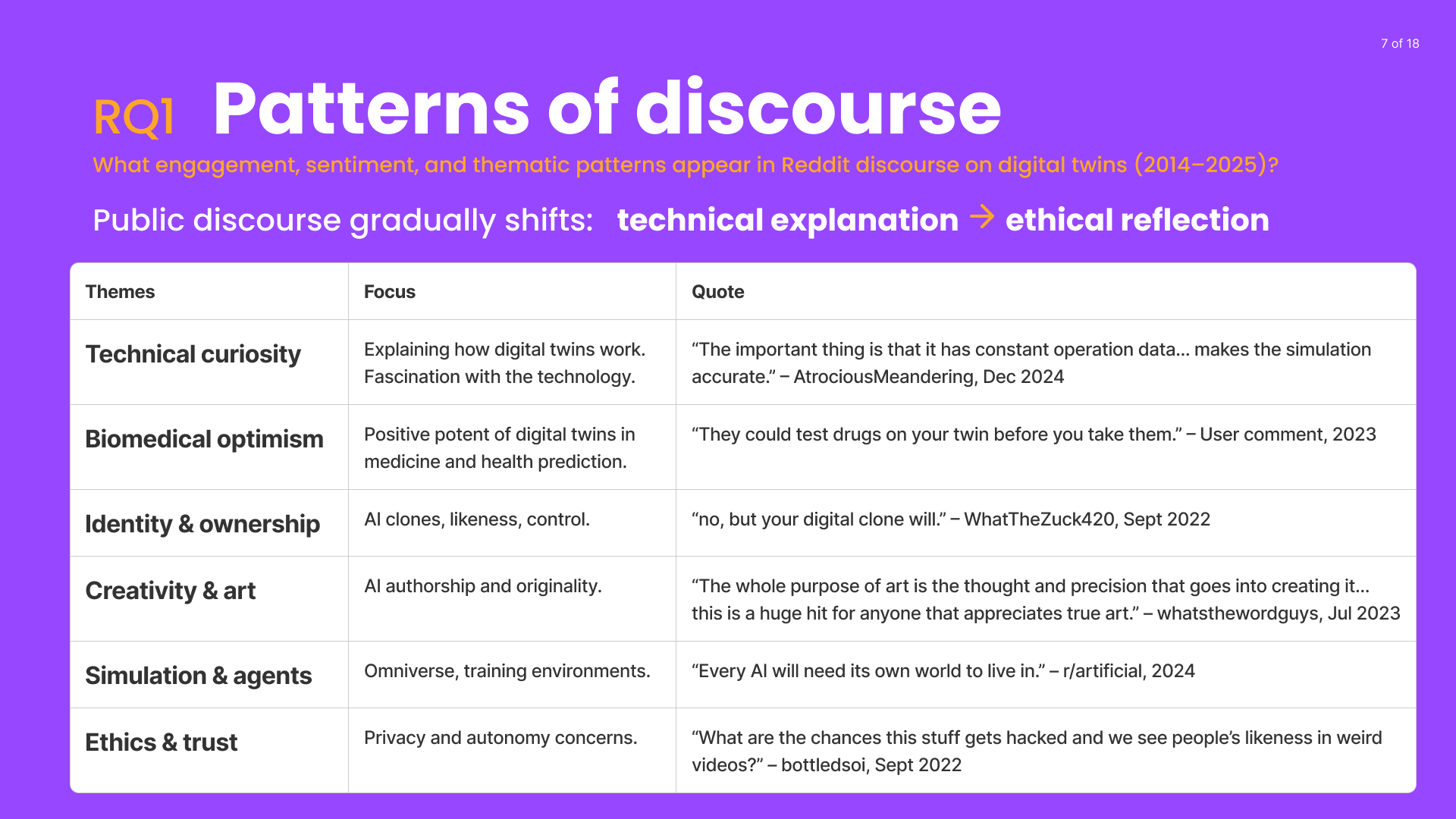
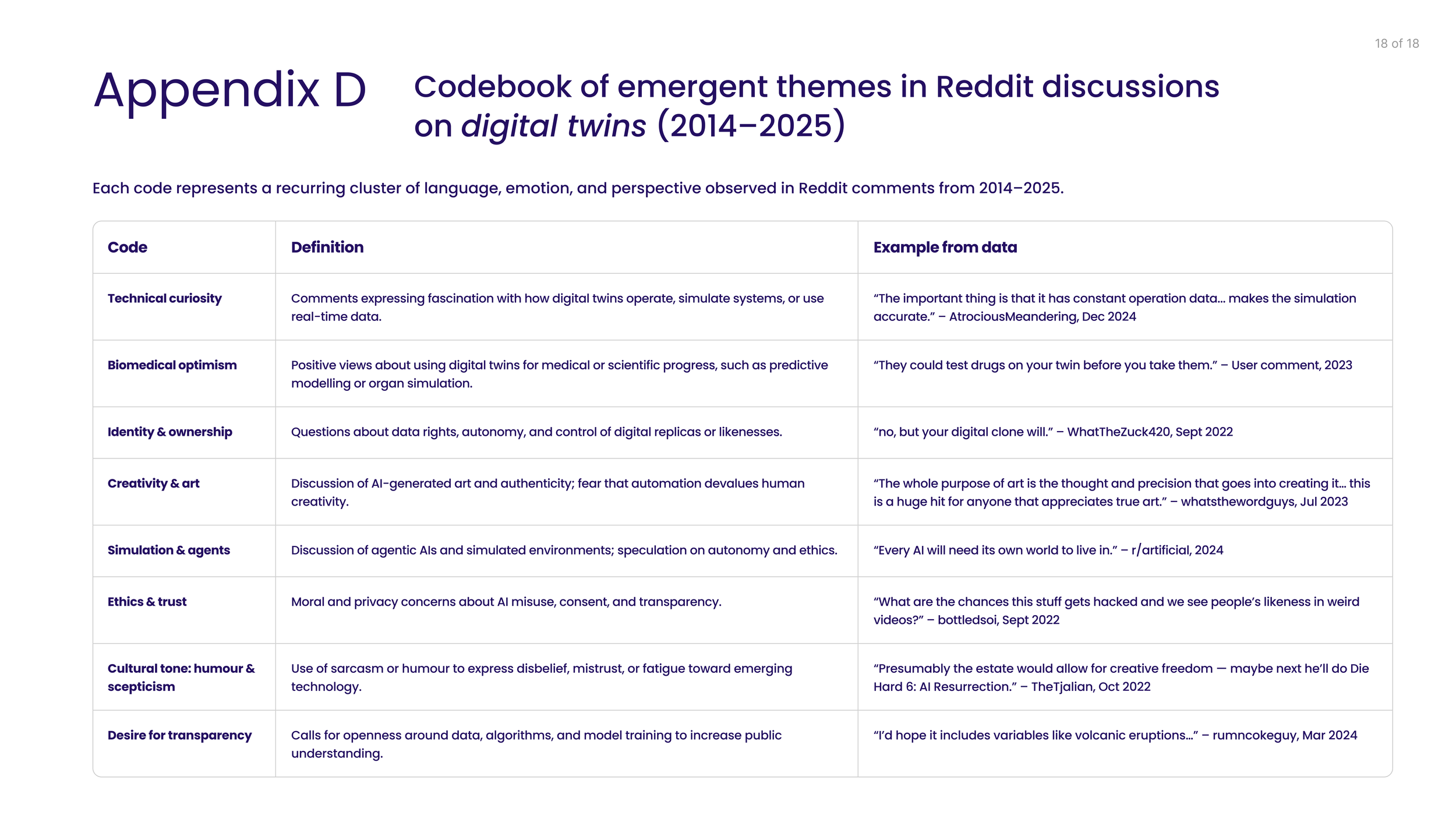
A presentation slide titled "Patterns of discourse" with a purple background. It discusses how Reddit discourse on digital twins shifts from technical explanation to ethical reflection, highlighting themes like technical curiosity, biomedical optimism, identity & ownership, creativity & art, simulation & agents, and ethics & trust. The slide includes brief descriptions and quotes related to each theme.
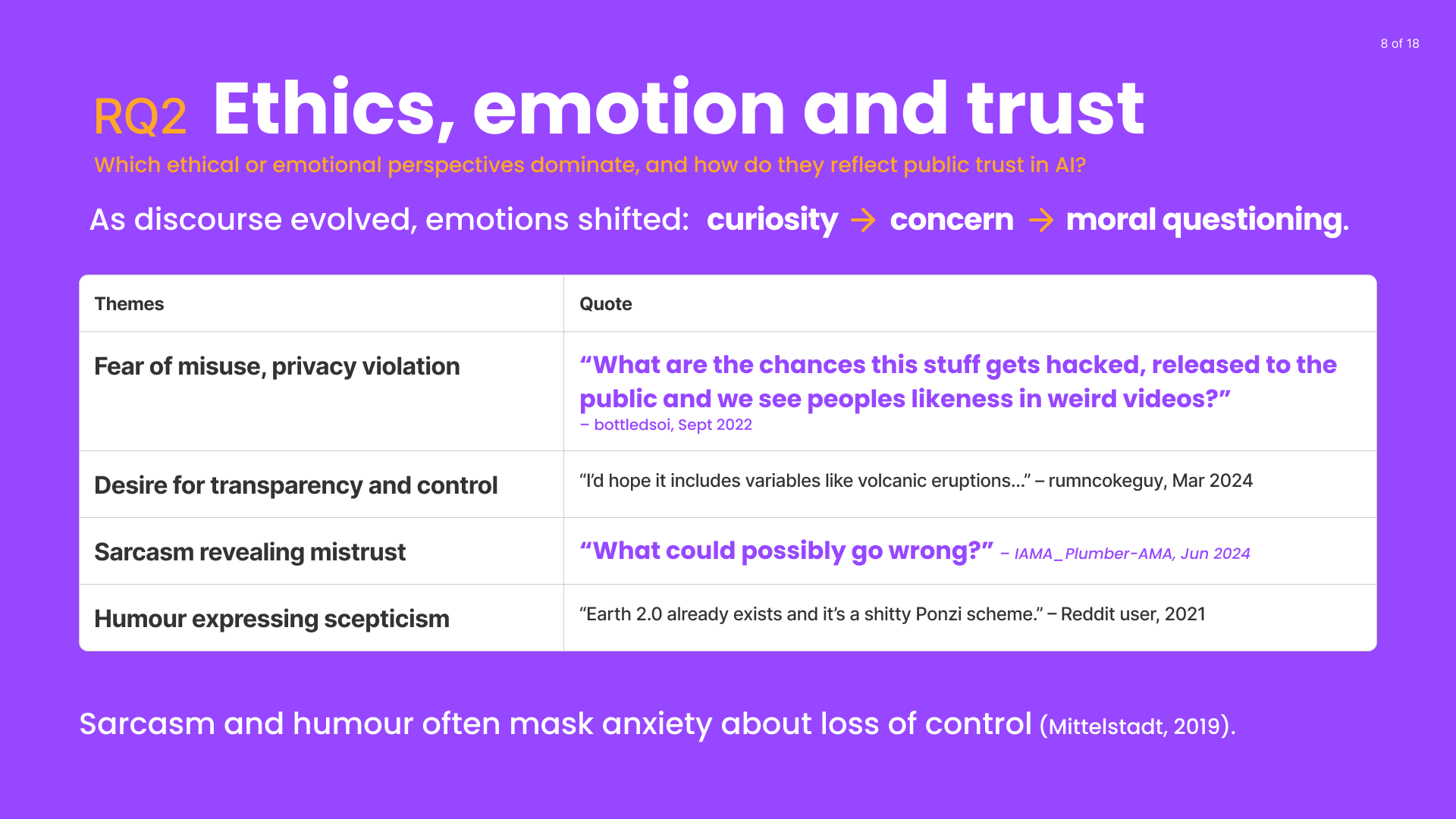
Purple slide with the title "Etiology, emotion and trust" and the subtitle "Which ethical or emotional perspectives dominate, and how do they reflect public trust in AI?" above a table with four themes: fear of misuse and privacy violation, desire for transparency and control, sarcasm revealing mistrust, and humor expressing skepticism, each with quotes. Additional text at the bottom states that sarcasm and humor often mask anxiety about loss of control.
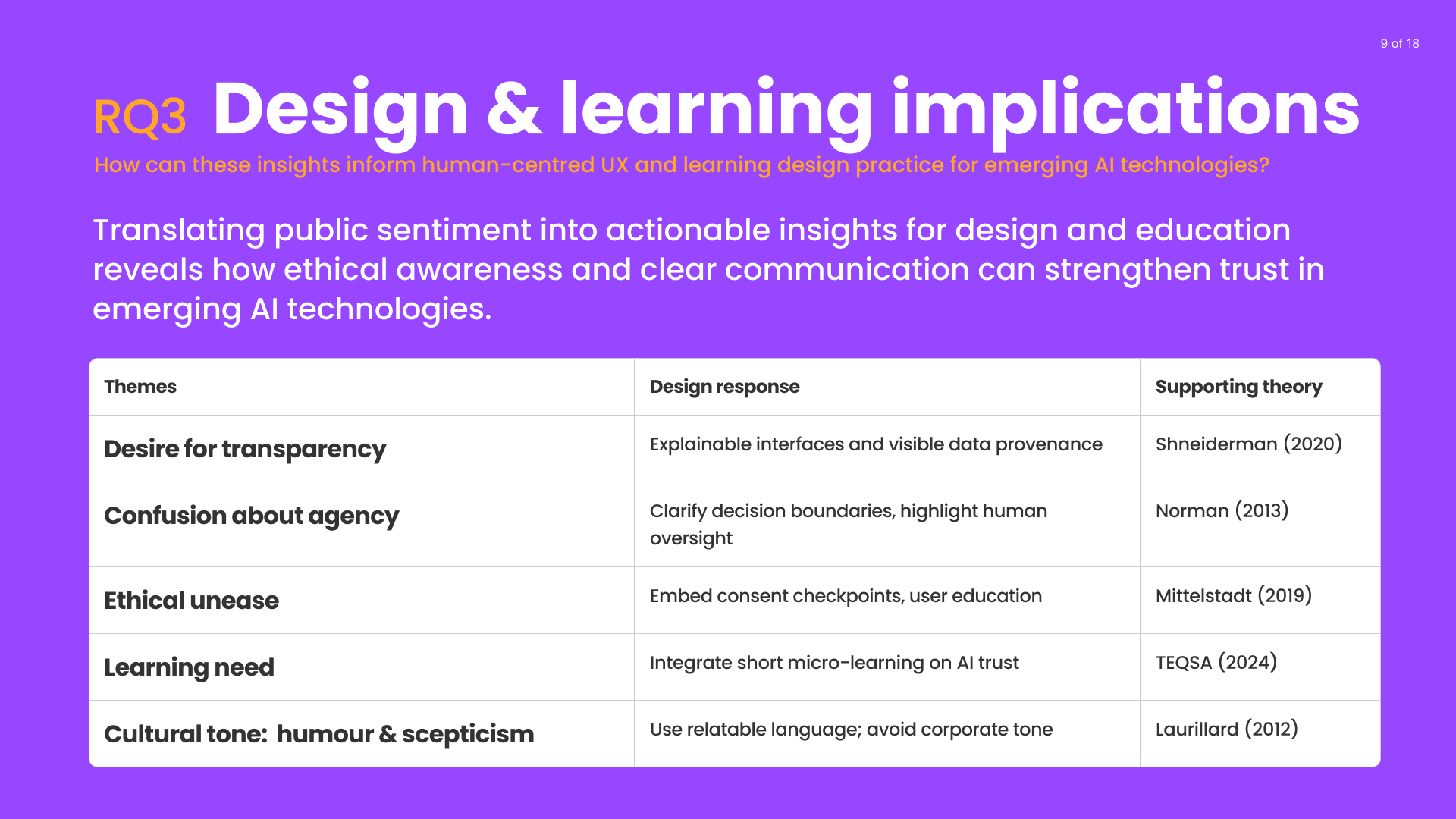
A slide titled "Design & learning implications" discussing how translating public sentiment into insights can enhance trust in AI. It includes a table with themes like transparency, agency, ethics, learning needs, and cultural tone, along with corresponding design responses and supporting theories.
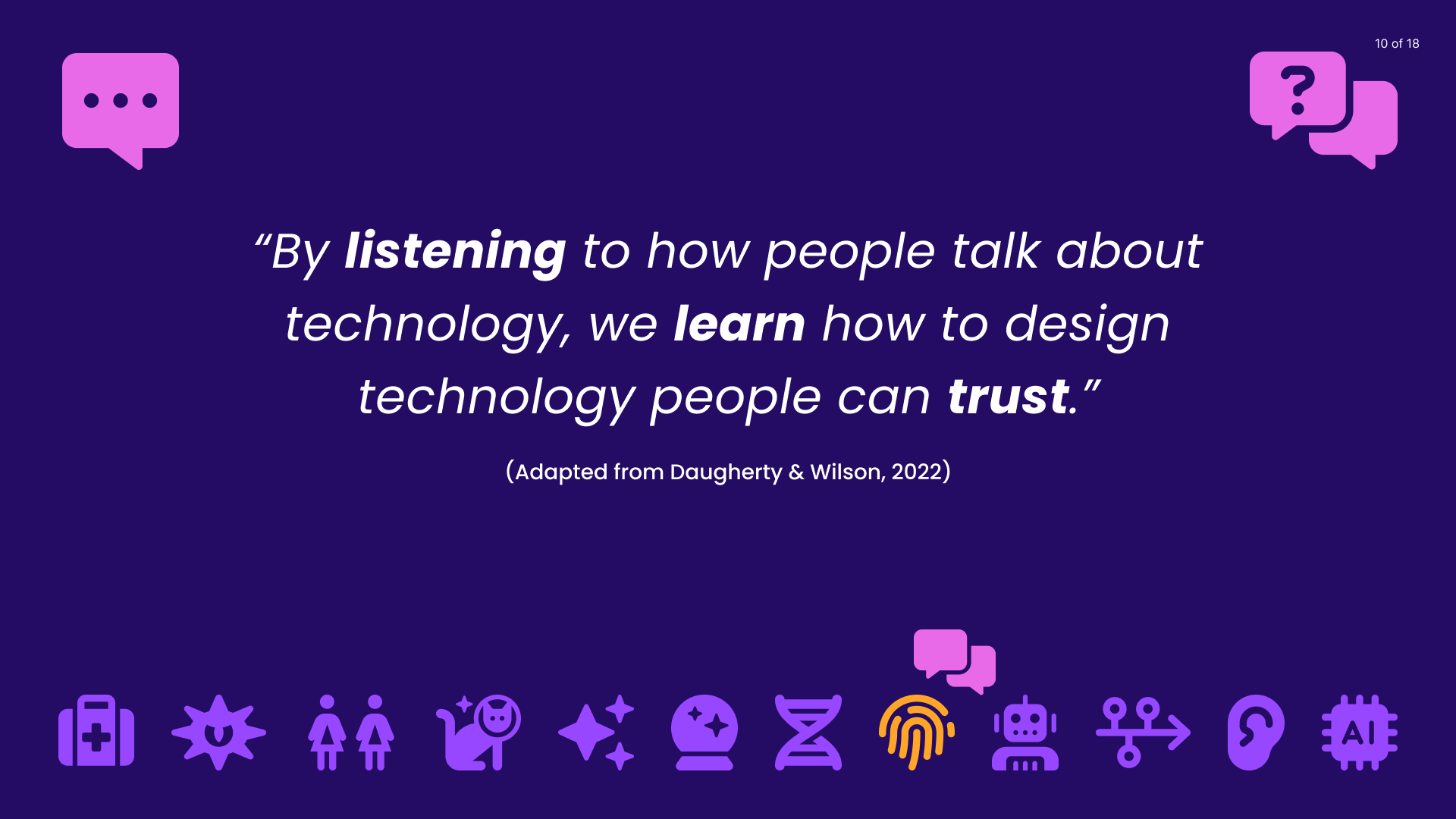
Quote about listening, learning, and trusting in technology with icons of a medical kit, a star, two women, a wizard, sparkles, a face, a DNA strand, a globe, a fingerprint, a robot, a network, a footprint, and AI in purple on a dark background.
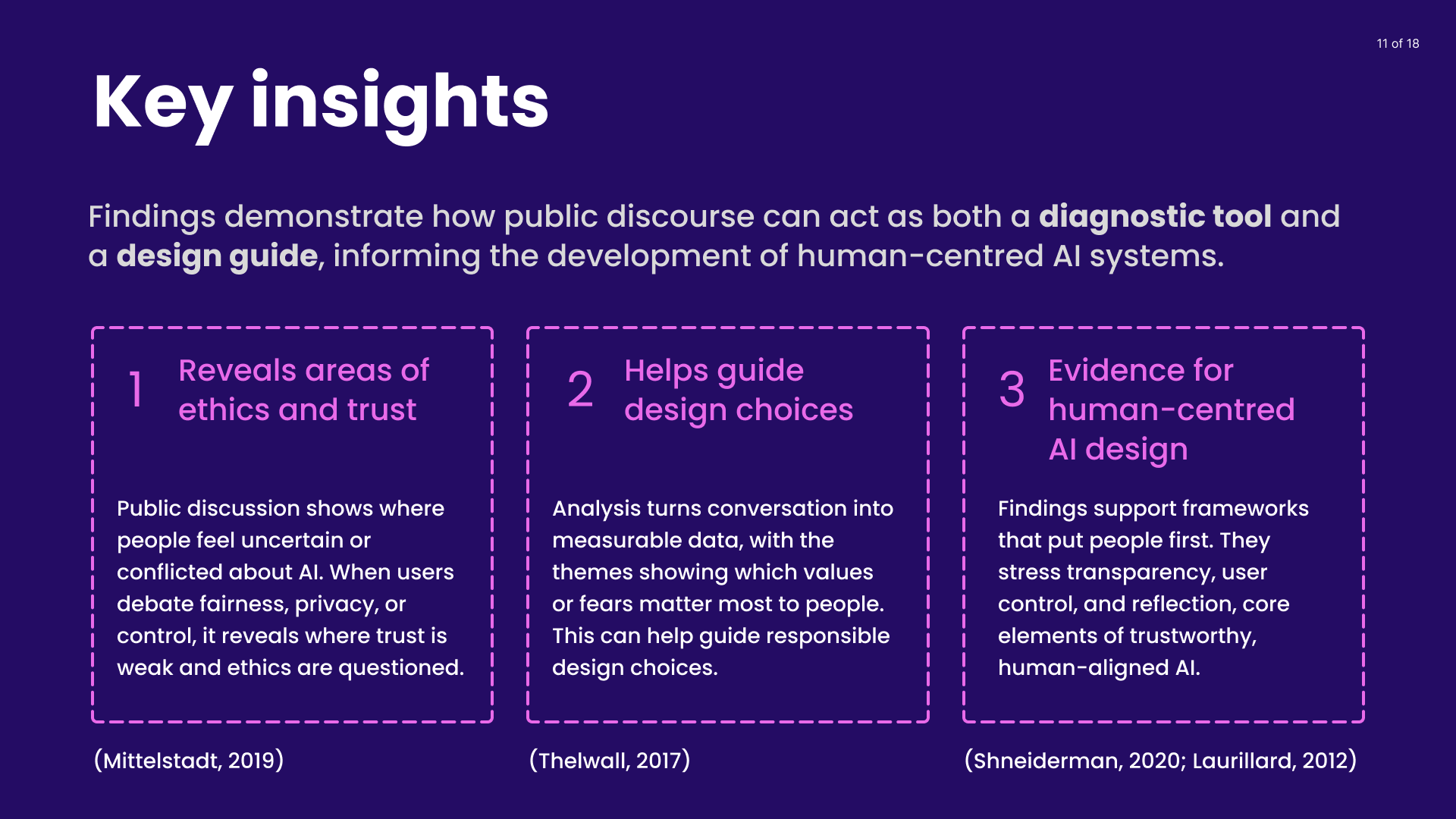
Slide titled "Key Insights" with three highlighted points in purple dashed boxes: 1. Reveals areas of ethics and trust, citing public discussion on uncertainty and conflicting opinions about AI, trusting ethics, privacy, and control. 2. Helps guide design choices with analysis turning conversation into measurable data, showing values or fears. 3. Evidence for human-centered AI design, with frameworks prioritizing people, transparency, control, reflection, and trust.
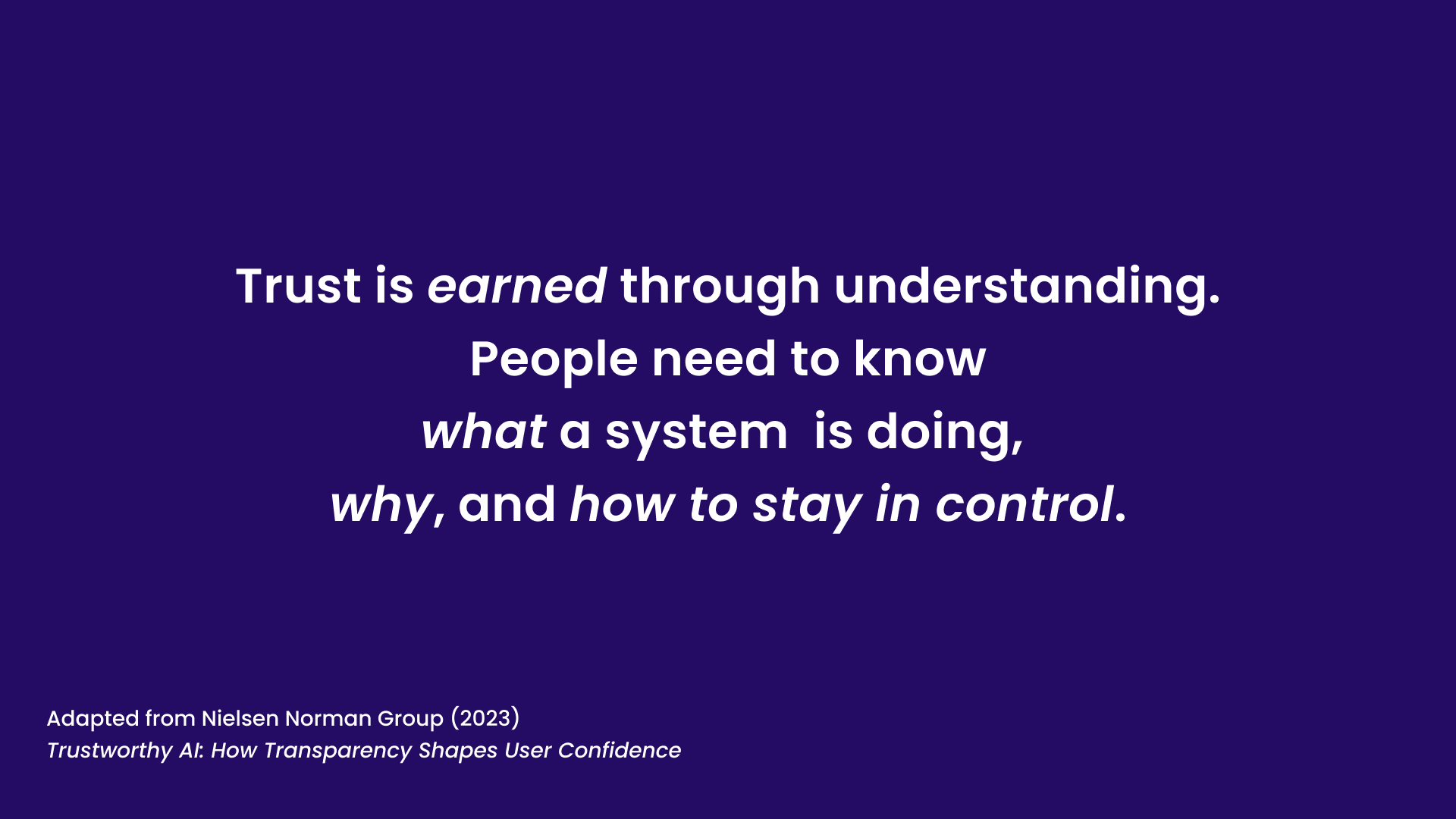
A quote on a dark blue background that states, 'Trust is earned through understanding. People need to know what a system is doing, why, and how to stay in control,' adapted from Nielsen Norman Group (2023), Trustworthy AI: How Transparency Shapes User Confidence.
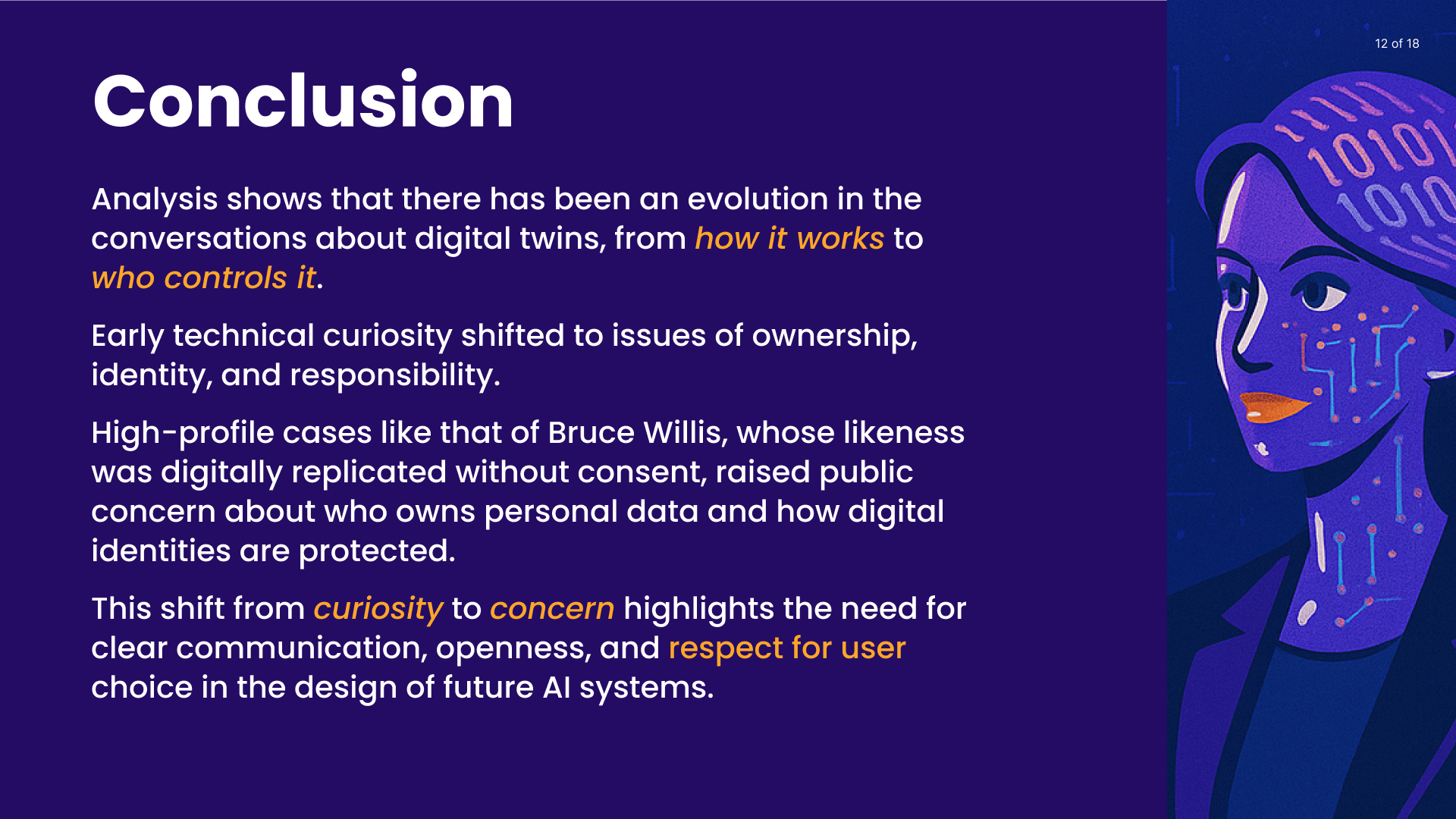
A digital illustration of a woman with pink hair, wearing glasses, with circuit patterns on her face and neck, next to a purple background with a conclusion paragraph on digital twins and AI systems.

Post Graduate Certificate in Digital Learning Design • Victoria University

(ADM6013) Analysing the Web and Social Networks

Assessment 2 results: HD • 97.5 / 100 • 39 / 40

Overall Comments

Congratulations on a stunning submission, Lisa — I absolutely love what you’ve done here. You’ve not only addressed every assessment criterion, you’ve taken us on a journey that surfaces new possibilities and even new destinations. I especially appreciated how you held three research questions in balance and answered each with clarity and discipline.

The standout highlight for me was the timeline of discourse. That level of contextual grounding shows both passion and genuine insight. I also valued the way you tracked patterns of discourse as signals and used them to progress your answers. Your insights shine a thoughtful light back onto the literature — it’s fascinating to see how ideas from 2012 hold up in today’s world, and you handled that comparison with care.

Overall, this is a brilliant piece of work, supported by a strong appendix. The grades reflect the effort and craft you’ve invested. Wishing you all the very best as you carry this forward.

Dr Natasha Dwyer, Victoria University 2025

Details

Social network analysis is a form of social listening and finding out what people think about an issue.
Your task is to uncover what people think about a particular issue. 

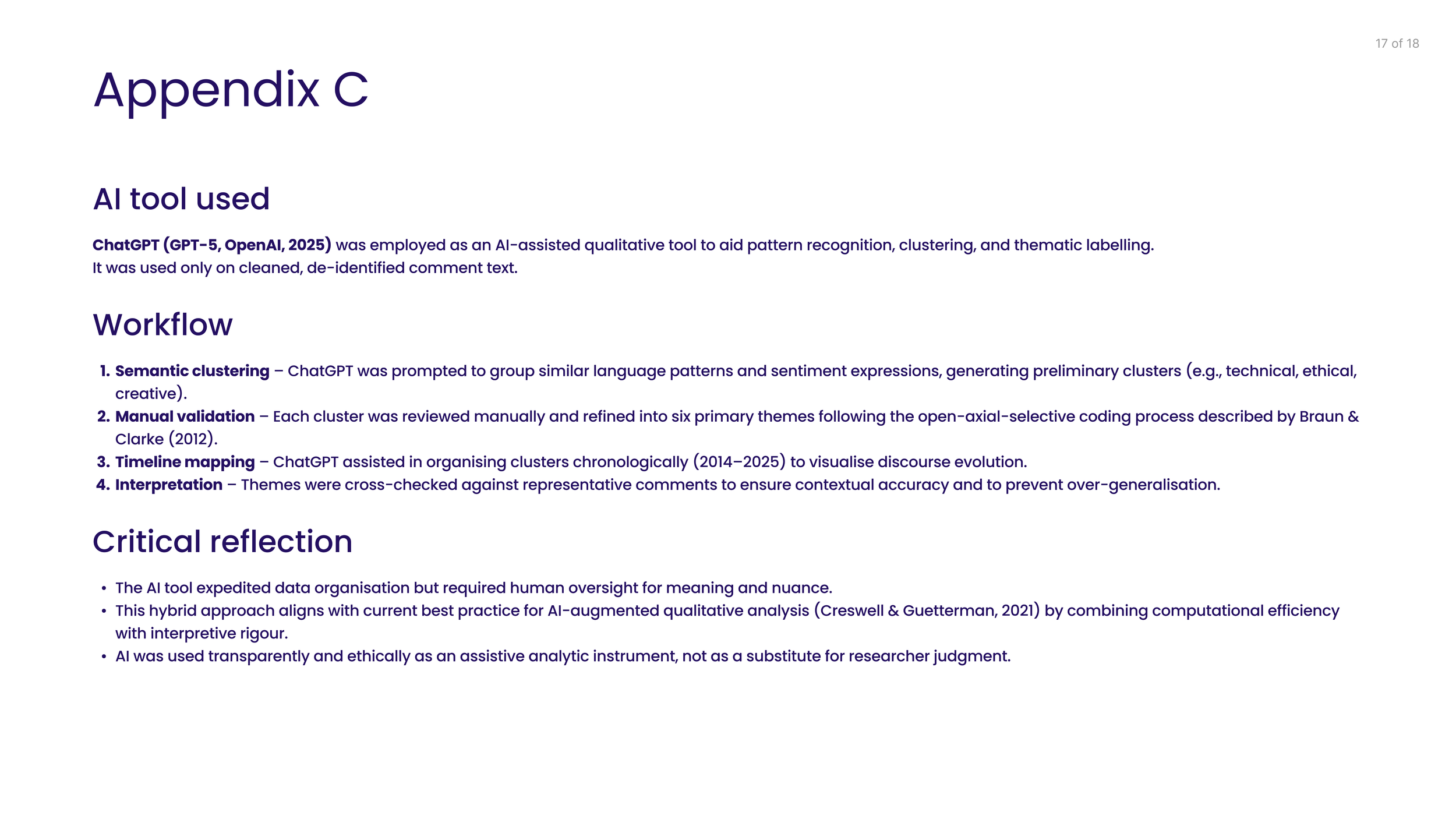
Please include notes about your use of AI in one of your slides. 
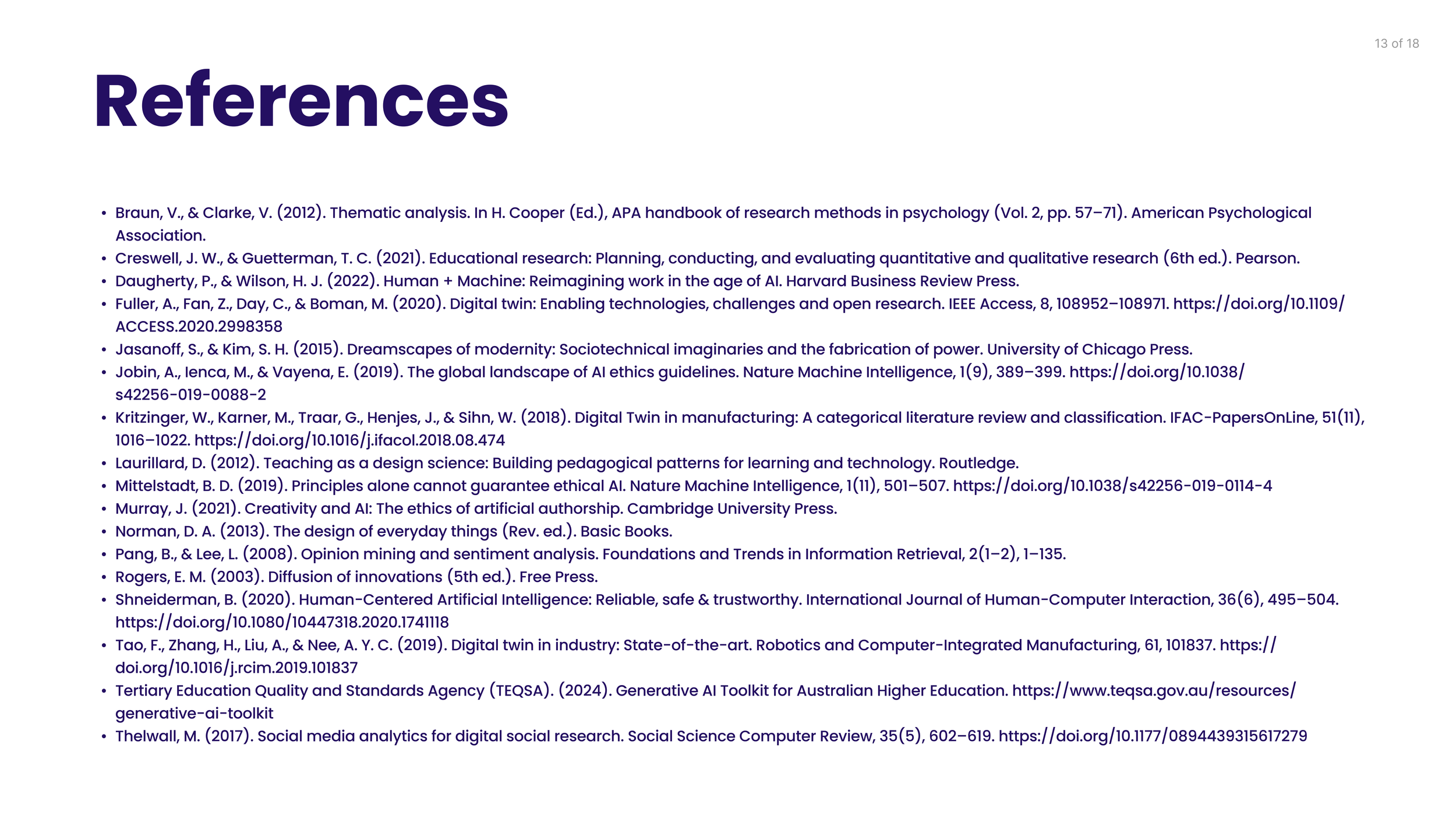
List of academic references including authors, publication years, titles, and sources in a presentation slide titled 'References'.
Academic references
Academic references
Academic references
Academic references
Academic references