


Deep Dossier
Unifying learning and teaching through a governed, system-led platform
Deep Monash Dossier Structure
For every major section in your public case study, add:
What the research already told us
What I synthesised
What decision this led to
What risk it resolved
Artefact anchor
This creates structured recall.
Operating Environment Research Baseline
(Pre-existing)
Source: 200-page institutional research document
Inputs included:
Teacher interviews
Student surveys
Support ticket analysis
LMS usage analytics
Faculty variation mapping
Governance concerns
Monash University’s Moodle environment evolved independently across faculties. Over time, this produced inconsistent structures, increased decision load for teaching staff, and uneven student experiences. Variation in layouts, terminology, and navigation limited scalability and made governance difficult. This work established a single, system-led learning model designed to operate consistently across a complex university environment.
The governed model operated within a platform supporting 86,558 students, approximately 9,000 academic staff, and more than 10,000 active units.
At a glance
System adoption: University-wide rollout across all faculties
Impact: Replaced faculty-specific unit layouts with one governed core system
Learning standard: Shared learning journey adopted institution-wide
Operating environment
Context
Organisation: Monash University
Environment: Enterprise LMS (Moodle)
Users: Teaching staff, students, faculty administrators
Role: Lead UX Designer
Timeframe: 6-month delivery window
Constraints
Existing LMS platform and data model
Faculty autonomy and legacy patterns
Governance and rollout timelines
What did the research actually say?
The research consistently showed structural inconsistency as the primary friction driver. Across faculties, navigation placement, terminology, and assessment positioning varied. That variation created orientation cost for students and setup cost for teachers.
Extracted Themes (Explicit)
You need to articulate these cleanly:
Theme 1 – Structural inconsistency
Different layouts per faculty increased orientation time.
Theme 2 – Assessment discoverability
Students struggled to locate requirements and deadlines.
Theme 3 – Decision fatigue for teachers
Unit setup required repeated layout decisions.
Theme 4 – Lack of scalable governance
No shared baseline pattern across faculties.
Theme 5 – Accessibility inconsistency
Templates did not guarantee compliance.
Add space under each where you later paste excerpts or screenshots from the research doc.
Problem Reframing
This was not an IA cleanup.
It was:
Distributed ownership without structural governance
Pattern variance at institutional scale
Cognitive load created by layout disorder
Visual 1 – Audit collage
Evidence anchor
→ proves structural variance
Decision it supports
→ standardised weekly module pattern
Risk addressed
→ Student orientation cost
Visual 2 – Journey
Evidence
→ proves repeated friction moments
Decision it supports
→ standardised weekly module pattern
Risk addressed
→ Student orientation cost
Visual 3 - LMS comparison
Evidence
→ proves pattern reuse in large platforms
Decision it supports
→ Adopt system-led model
Risk addressed
→ Reinventing per faculty
Visual 4 - Decison logic
Evidence
→ proves explored alternatives
Decision It Supports
→ chose governed template over rigid standardisation
Risk Addressed
→ Loss of flexibility
Fragmentation as a system problem
PART 1
Structural variation at institutional scale
Monash’s Moodle environment evolved faculty by faculty. Each area owned its own unit layouts, navigation patterns, and terminology.
Over time, this created wide structural variation across units. Students moving between subjects encountered different ways of finding learning materials, assessments, and progress indicators. Teaching staff rebuilt structures manually, with no shared baseline to guide consistency.
The friction was not driven by course content.
It was driven by structure.
Observed conditions included:
inconsistent navigation and hierarchy
learning and assessment content appearing in different locations
differing terminology across faculties
no shared structural pattern to support scale or governance

Visual 1 - Independent faculty layouts produced inconsistent navigation, terminology, and content placement across units.
Where the experience broke for students
The same friction points appeared repeatedly across disciplines. Students struggled to locate weekly learning, understand assessment requirements, and track progress. These issues were identified in prior institutional research and confirmed through unit audits and stakeholder walkthroughs.
The pattern pointed to a systemic issue rather than isolated usability defects.
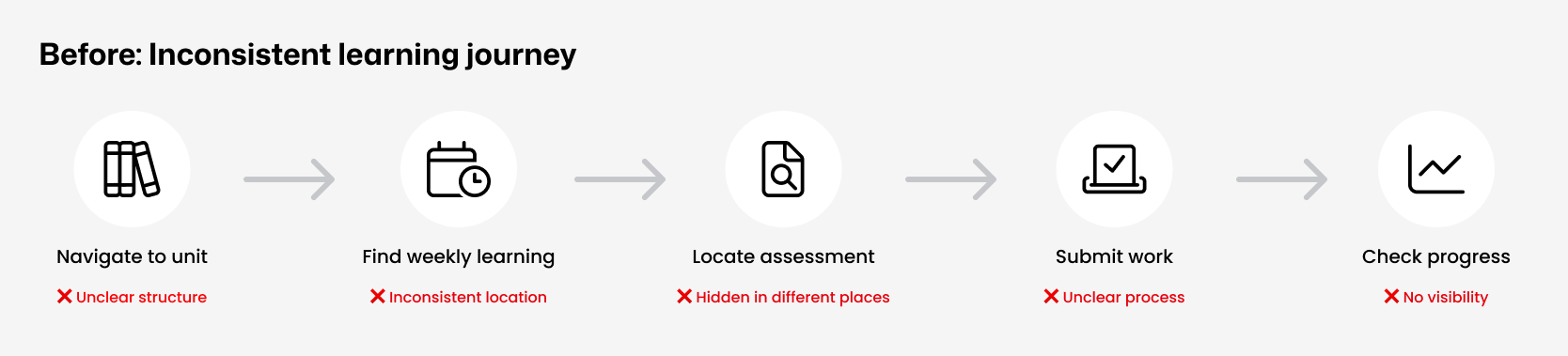
Visual 2 - A simplified student journey highlighting repeated friction caused by fragmented structure.
Insight
The breakdown was structural, not visual or discipline-specific.
Learning from large-scale platforms
Internal exemplars and external LMS platforms were reviewed to understand how large institutions maintain coherence at scale.
Key observations:
pattern recognition supports faster orientation
pattern reuse reduces cognitive load
safe defaults support staff while enabling governance
consistency does not constrain pedagogy
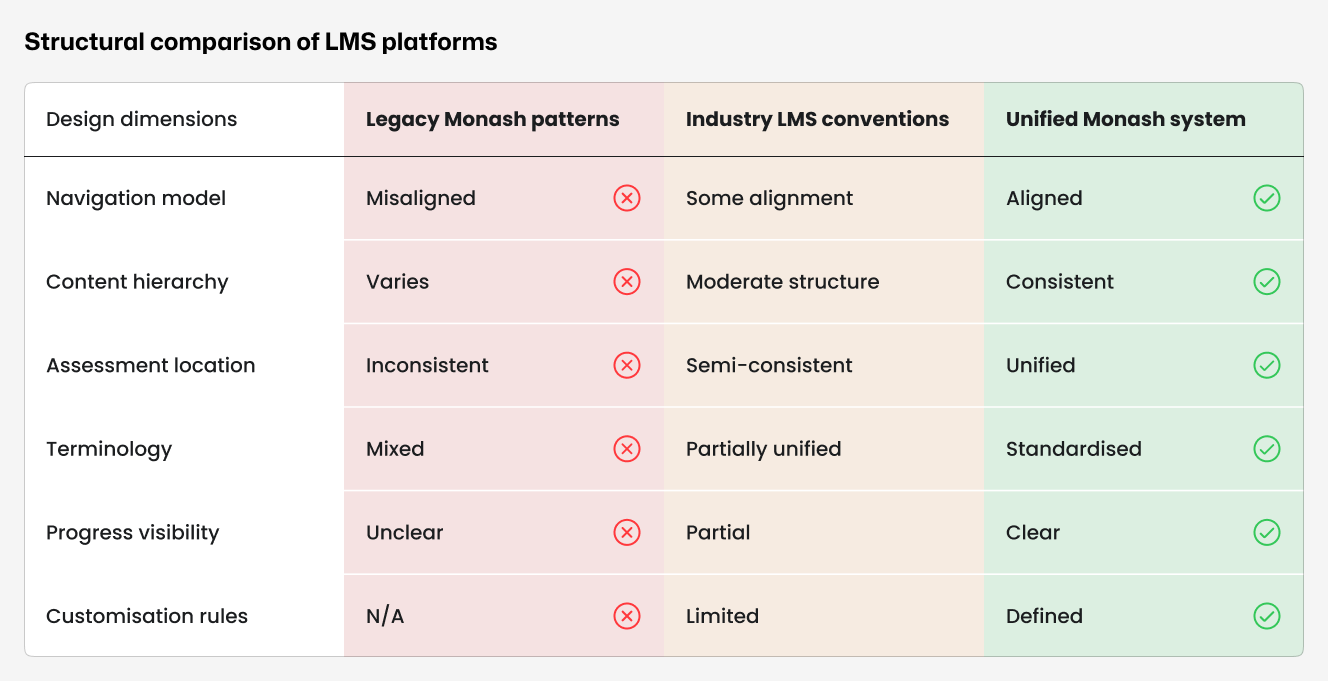
Visual 3 - Fragmented versus governed learning portals.
Choosing a system-led approach
Addressing scale required a shift from designing individual pages to designing a system.
The strategy focused on a centrally governed structure that could operate consistently across faculties while allowing flexibility within defined boundaries.
Strategic intent:
standardise core unit structures
prioritise predictable placement over visual variation
constrain customisation to defined zones
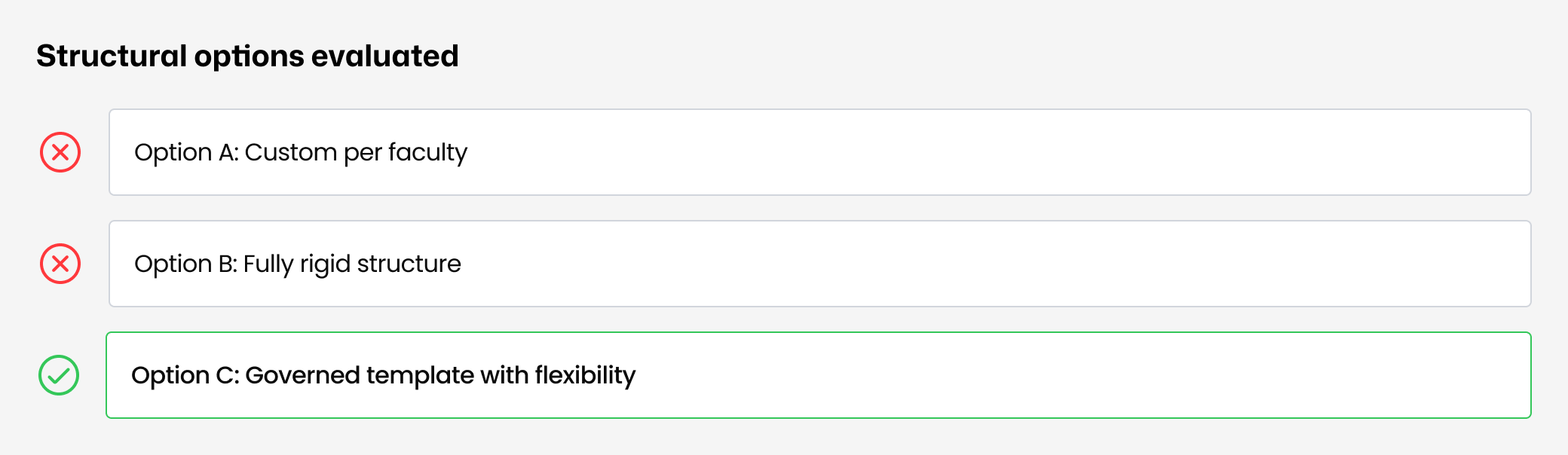
Visual 4 - Decision logic comparing local layouts, rigid standardisation, and a governed template model.
Visual 5 – Before/After
Evidence
→ proves structural shift
Decision it supports
→ Enforce consistent placement
Risk addressed
→ Competing navigation
Visual 6 – Unit structure
Evidence
→ proves structural shift
Decision it supports
→ Enforce consistent placement
Risk addressed
→ Competing navigation
Designing a governed, modular learning system
PART 2
Establishing a shared structural foundation
The response was not a new set of pages.
It was a modular system providing a repeatable foundation across faculties.
A governed template established consistent placement for learning content, assessments, and progress indicators. Units inherited this structure rather than rebuilding it.
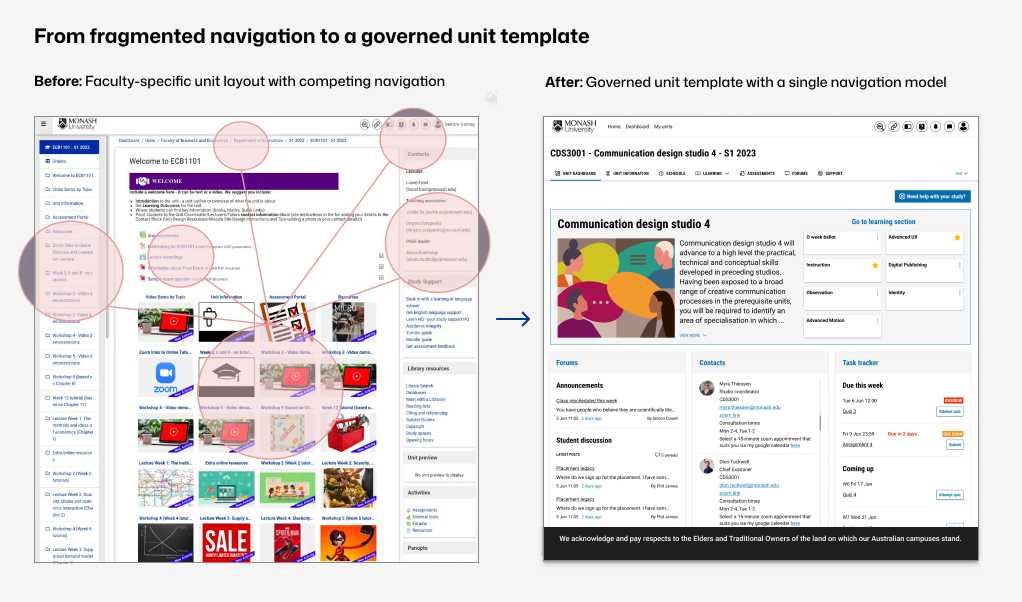
Visual 5 - A single governed template replaced faculty-specific layouts, reducing competing navigation patterns while preserving flexibility for unit content.
How the system operates
The template expressed a complete unit structure:
a consistent homepage
predictable weekly learning modules
dedicated assessment zones
clear orientation and progress cues
This reduced variation without constraining teaching approach.
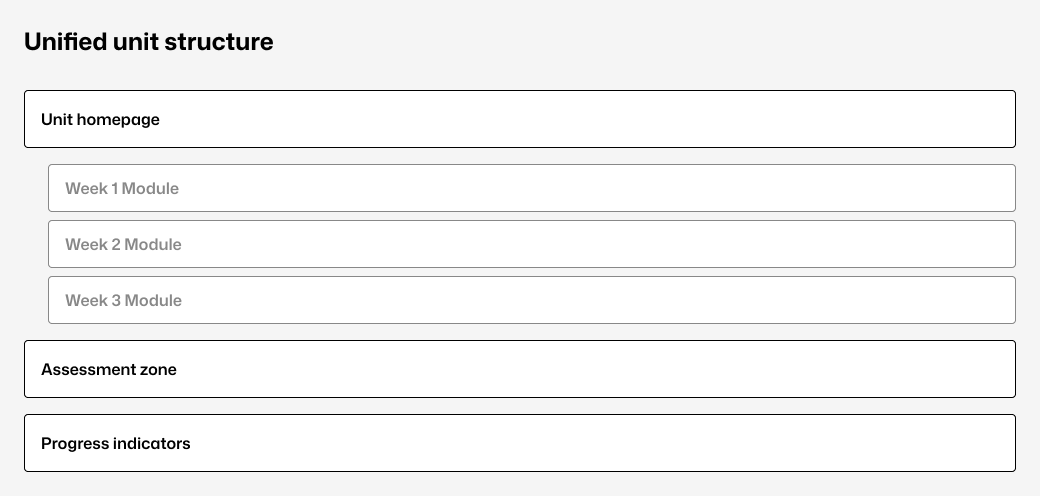
Visual 6 - End-to-end unit structure operating as a single system.
System intent
The system was designed to:
reduce setup effort for teaching staff
improve student orientation across units
support accessibility, governance, and long-term maintainability
Predictability was treated as a design requirement.
Proving flexibility across faculties
Templates were applied across multiple disciplines to validate use beyond a single context. The structural framework remained constant while content varied by faculty, delivery mode, and pedagogy.
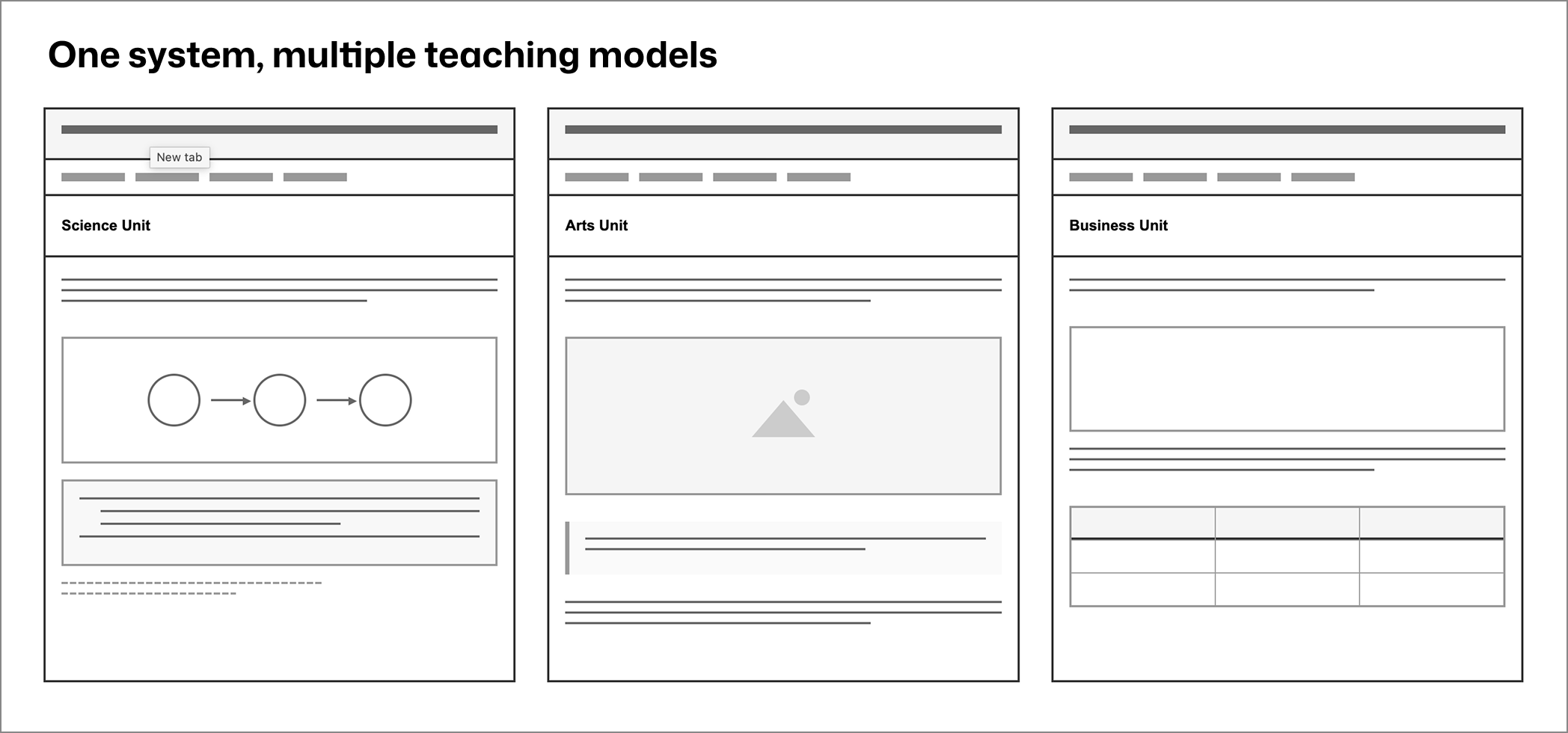
Visual 7 - Wireframes showing how a single governed structure supports discipline-specific content without fragmenting the student experience.
Establishing a shared learning journey
A reusable learning journey replaced inconsistent terms such as “before, during, after class”. The model clarified how students progress through a unit and was adopted as a university-wide standard.
Visual 8 - A short explainer video clarifies the stages of the shared learning journey and the role of task trackers in supporting progress across a unit.
Decision
Establish a single learning journey as an institutional standard.
Testing and iteration
Templates were refined through structured feedback sessions with students and teaching staff and validated against real course scenarios. Testing focused on cross-discipline suitability and accessibility.
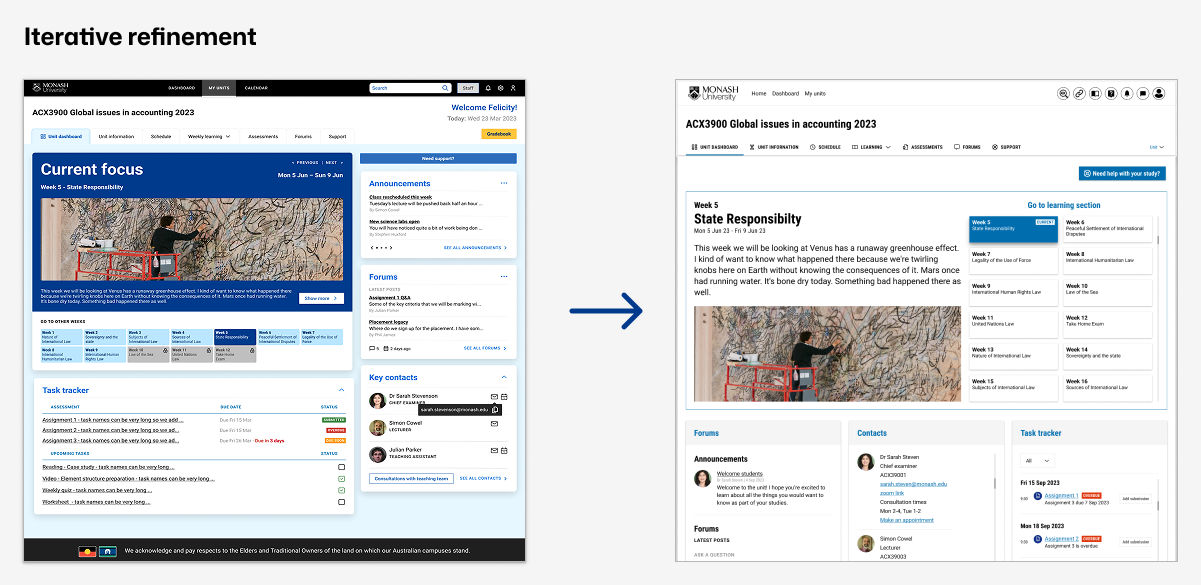
Visual 9 - Template and dashboard refinements informed by structured feedback from teaching staff and students.
Constraints and trade-offs
The initial brief directed exploration away from Monash’s existing visual system. Late in delivery, a mandate required full alignment with central brand standards.
Visuals were updated to meet this requirement while preserving structure and timelines.
Impact and evidence
PART 3
Platform-level impact
Students navigated units using consistent structural cues regardless of faculty. Teaching staff worked from a governed baseline rather than rebuilding layouts. Moodle shifted from local variation to a platform-level system.
Impact signals:
structural consistency across faculties
reduced time-to-publish using safe defaults
recognised internally as a benchmark for the Digital Learning Uplift
Institutional evidence
Feedback from university leadership and product stakeholders confirms platform-level scalability and governance.
Institutional Scale
Your design will be reproduced EVERYWHERE. You put your artistry into a dull place and it is so much better for it.
Professor Allie Clemans
Acting Deputy Vice-Chancellor (Education), Monash University
Platform Transformation
Your efforts have gone above and beyond achieving our goal of making Moodle a contemporary platform that redefines learning and teaching.
Trevor Woods
Manager, Educational Platforms,
Monash University
Product Quality
Lisa has a unique ability to blend creativity with user-centric design principles, prioritising the end user’s experience.
Ankur Adrawal
Product Owner, LMS Redesign, Monash University
Outcome
The system was recognised as scalable and institution-ready.
Reflection: designing for scale
Consistency functions as a service in large institutions. Shared structures reduced friction while enabling governance and long-term evolution. The most durable outcome was not a single interface, but a system designed to scale.
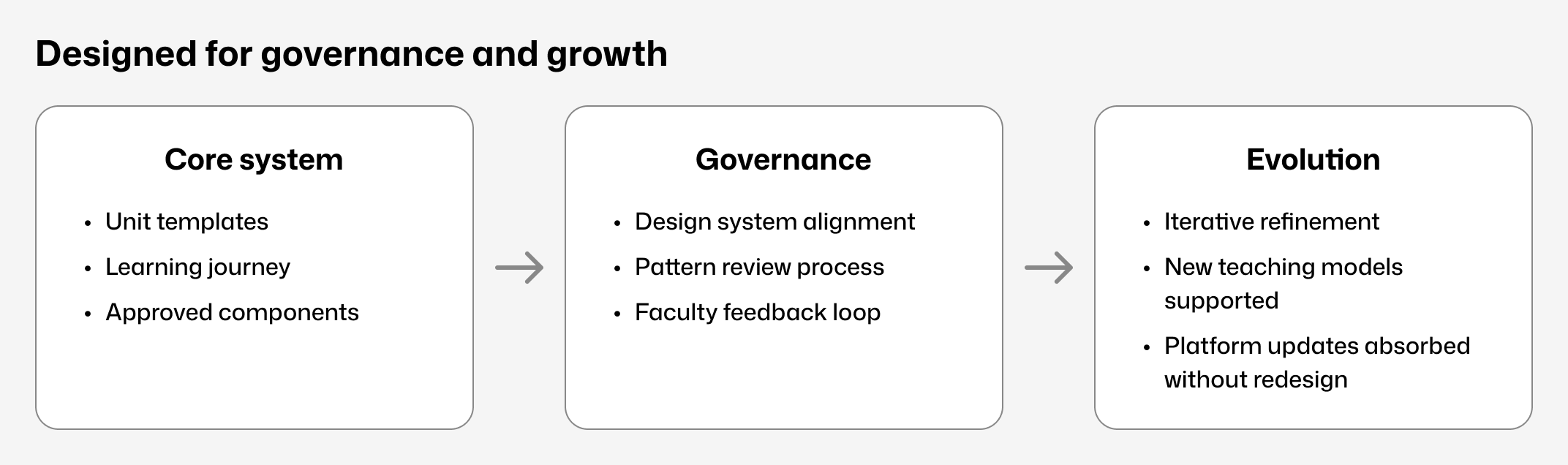
Visual 10 - Forward view of the learning management system, showing how a governed core supports ongoing evolution, new teaching models, and platform updates without structural redesign.